


Twenty One Pilots Turn Riot Fest Into a High-Wire Spectacle
Updated: Sep 30
The Hot Spots Network – Riot Fest 2026 Coverage
Photos by Rachel Zyzda
Twenty One Pilots didn’t simply take the stage at Riot Fest 2026—they erased the boundary between the stage and the audience.
From the opening moments, Tyler Joseph and Josh Dun transformed their set into a tightly controlled collision of alternative rock, hip-hop, electronic music and theatrical spectacle. The performance felt carefully designed without ever becoming predictable. Every lighting change, masked appearance and sudden burst of movement added to the tension, but the emotional connection between the duo and its audience remained the real center of the show.

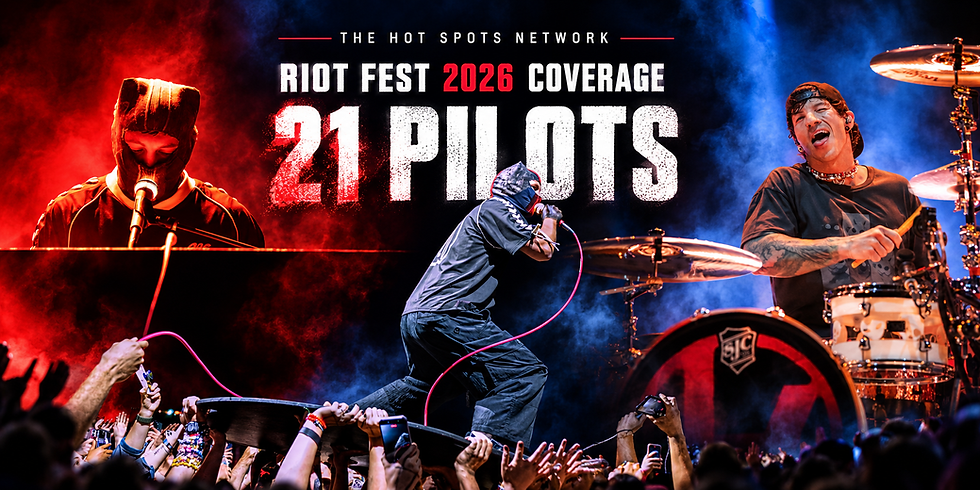
Joseph emerged beneath intense red lighting, his face concealed by a mask as he leaned into the microphone. The image immediately established the performance’s mood: mysterious, confrontational and cinematic. He shifted naturally between vocals, piano and physical movement, delivering each transition with the urgency of someone determined to reach every corner of the festival grounds.
That urgency eventually carried him directly into the crowd.
Supported above a sea of raised hands, Joseph continued performing while balancing on a platform held aloft by fans. It was a spectacular visual moment, but it also represented something fundamental about Twenty One Pilots. Their concerts depend on trust and participation. The audience is not treated as a backdrop - it becomes an essential part of the production.

Joseph’s bright microphone cable curved through the darkness as fans reached toward him with phones and hands raised. The scene captured the controlled chaos of the performance: one artist suspended above thousands of people, still completely connected to the music.
Behind the kit, Josh Dun provided the muscular foundation that allowed everything else to move so freely. His drumming was explosive without sacrificing precision, driving the performance through its sharp changes in tempo and atmosphere. Dun plays with his entire body, and his visible enthusiasm gave the heavier moments additional force while bringing a sense of celebration to the set.

The visual contrast between the two performers was particularly effective. Joseph frequently appeared surrounded by darkness, red light and shadow, while Dun was illuminated against warmer tones and flashes of electric blue. That contrast reinforced the duality at the heart of the band’s music: anxiety and release, isolation and community, vulnerability and spectacle.
Although Twenty One Pilots can fill a performance with masks, dramatic lighting and carefully constructed imagery, none of those elements overwhelmed the songs. Instead, the production amplified the emotions already present in the music. Quiet passages created genuine anticipation before drums, electronics and audience voices pushed the performance back toward its next peak.
Their genre-fluid sound also proved especially effective in the Riot Fest environment. The duo moved comfortably between rock aggression, rhythmic verses, melodic choruses and atmospheric electronic passages. That refusal to remain in one musical lane allowed the performance to feel accessible while retaining its own distinctive identity.

Festival sets can sometimes feel like abbreviated versions of an artist’s regular production. This one felt complete. Twenty One Pilots understood the scale of the occasion and delivered a performance created to fill both the stage and the open air surrounding it.
More importantly, they understood how to make a massive festival audience feel personally involved. Fans sang, reached upward and carried Joseph above them, turning the performance into a shared act rather than a one-directional presentation.
At Riot Fest 2026, Twenty One Pilots demonstrated why they remain one of the most compelling live acts of their generation. The music was powerful, the imagery was unforgettable and the physical commitment from both performers never wavered.
By the end, the duo had delivered much more than a collection of songs. They created a living, moving spectacle—one built on tension, release and an extraordinary level of trust between the artists and the people watching them.



Comments